
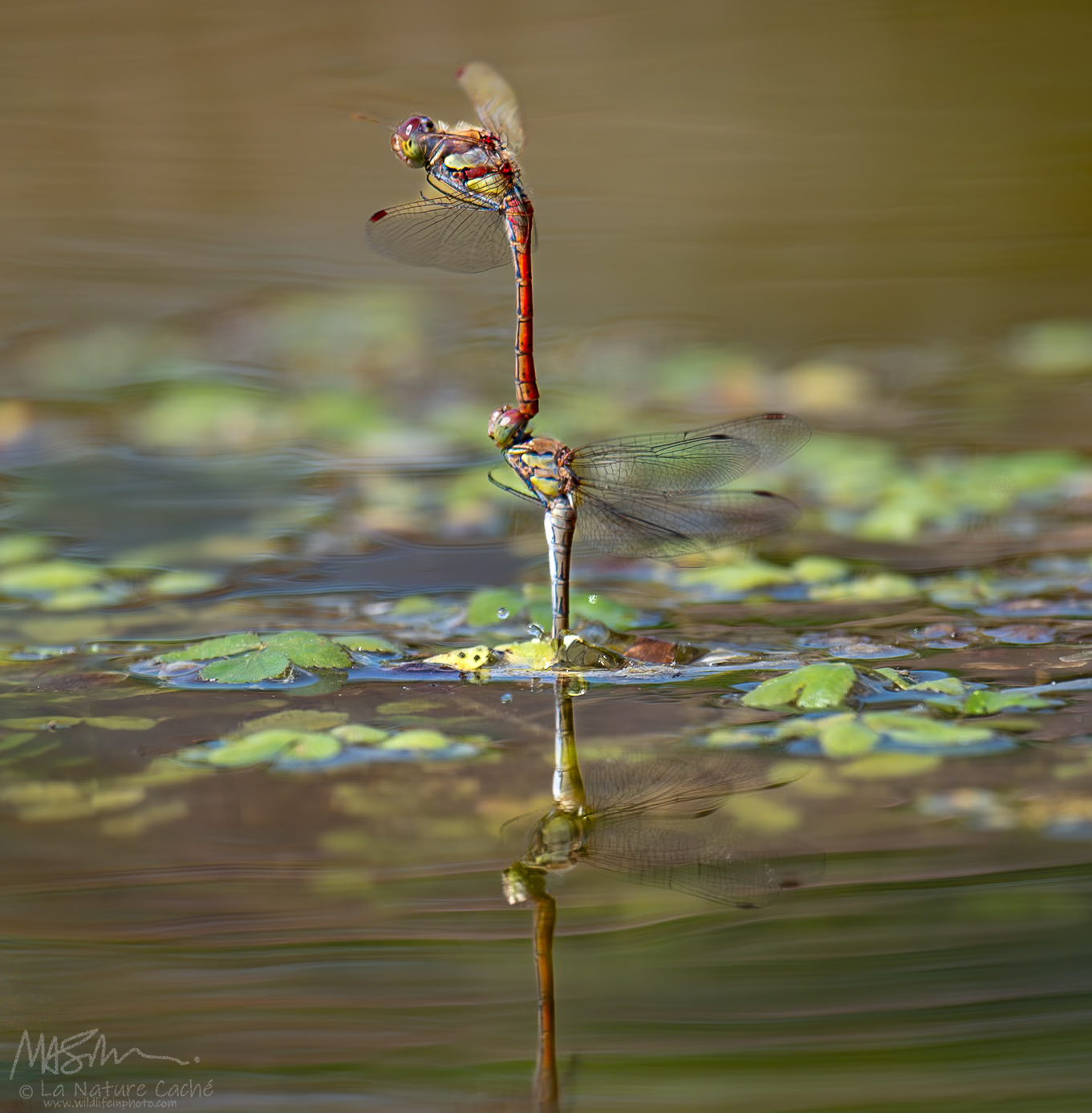
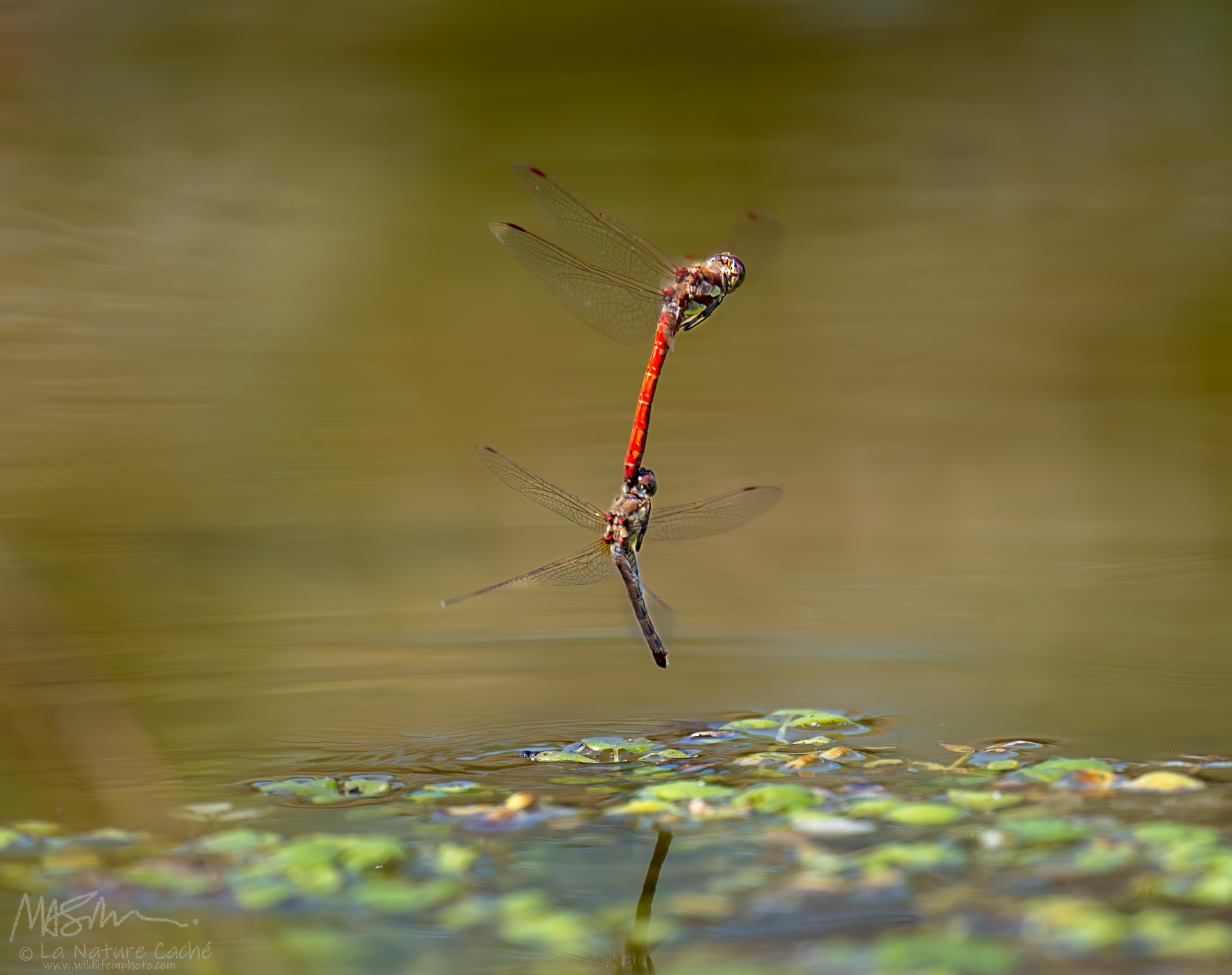
Been working on technique and observation throughout the summer. This has been a real challenge. Even shooting 10 fps, the exact moment can fall between two shots, so that’s not an easy solution.
The aim was a full frame image so the 500mm f4 lens was the tool. Shooting wide open for the crispest image gives a depth of field of just a few centimetres at the lenses closest focus distance of 3.8m.
These shots used a low tripod with a very mobile 360 degree fluide head, but I was having some success regarding nailing the focus in previous hand-held bursts, but the tripod allowed focus lock to be quickly engaged between their ‘dips’.
I did manage a capture mid-summer which was more distant; one can’t influence where in the pond they choose to lay. However, one of the patterns, if you can call it that, of this species seemed to be to cruise possibilities, start laying then the frequency of one place increased.
Fortunately on this occasion their choice was not only a weed patch 4m from the lens, but the angle of the capture provided an uncluttered backdrop which, with the beaubokeh of this lens, made the stars aligned.
Several failed attempts using burst mode and then I moved to timing the the dip of their flight, which for a few repeats seemed to have a fixed interval, with a burst of 3 shots at 10fps.
The big issue though was focus! I did use AF but this particular pair of images was AF on the spot they last dipped at, then focus lock and Hey Presto! Next shot was spot-on with timing and focus. The image flying away was actually from an earlier attempt where I missed the dip but was on 3D Group AF so tracked the flight to maintain focus.
It was fun, frustrating, often very hot being sat in full sun for 30 minutes, but ultimately I learned a lot about these very rapid flyers as well as the technique. I’m sure this will be my last opportunity this year. I hope next year to move the project up a level….not sure how yet, but the Emporer Dragonfly is even faster, so that will be more difficult, though the size makes the AF more feasible.
The camera settings were generally 1/3200s, iso320 and full aperture f4 with the Nikkor 500 f4. Focal length is 750mm and virtually at minimum focus of 4 metres. In-camera settings were biased for contrast and sharpness. However, not so important as it was always going to need some tweaking in Lightroom. Exposure was the most important consideration, but choosing to have the sun behind and from the right, and being so close to the reflective water surface, meant spot metering highlight biased was great to avoid blown highlights or reflection from the shiny exoskeleton, without the shadow-side of the insect being underexposed.
à bientôt
 WILDLIFE IN PHOTO